Stackable Banana Plug 4mm Male Test Lead Jumper Wire 5pcs Pack (TA1771) Products
| Name | Stackable Banana Plug 4mm Male Test Lead Jumper Wire 5pcs Pack |
| Code | TA1771 |
| Price | Rs.1,900.00 |
| In Stock | Yes |
Product Details
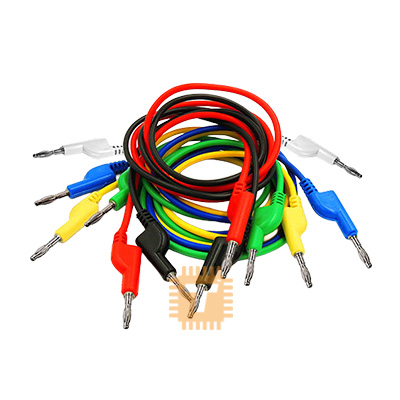
This 5-piece pack of stackable test leads features 4mm male banana plugs on both ends of each wire. The distinctive "stackable" or "piggyback" design includes a built-in 4mm female socket on the back of each male plug. This allows you to plug another banana lead directly into the back of an existing connection, making it simple to split signals, create parallel circuits, or daisy-chain diagnostic equipment without messy wire twisting.
Specifications
- Plug Size: 4mm (Standard industry size)
- Plug Type: Male with integrated Female rear stackable socket
- Contact Material: Nickel-plated beryllium copper or brass for optimal conductivity
- Insulation Material: Flexible PVC or Silicone shroud
- Wire Gauge: Typically 18 AWG to 20 AWG multi-strand copper
- Maximum Current Rating: 15A (Typical for standard PVC/Silicone test leads)
- Maximum Voltage Rating: 30V AC / 60V DC Designed for hands-on bench testing; non-CAT rated)
- Lead Length: Standard variants usually range from 20cm to 30cm
- Pack Quantity: 5 pieces (Standard color-coded pack: Red, Black, Yellow, Green, Blue)
Features
- Piggyback Stacking Capability: Allows for multi-point connections from a single terminal jack. You can stack multiple leads on top of one another to distribute power or ground rails across several test points simultaneously.
- High Flexibility Leads: Constructed with high-strand-count wire inside a soft insulation jacket, ensuring the cables drape smoothly, resist tangles, and do not pull lightweight test gear off the workbench.
- Lantern-Type Spring Plugs: The male tips utilize a leaf-spring or lantern-style split expansion barrel, ensuring tight mechanical tension and low contact resistance when inserted into standard 4mm binding posts.
- Molded Strain Relief: Heavy-duty boots are molded directly onto the wire-to-plug junctions, preventing internal wire fraying caused by repeated pulling and bending.
Common Applications
- Laboratory Bench Testing: Connecting variables like digital multimeters, oscilloscopes, and functional generators to a central prototype circuit.
- Educational Physics Labs: Allowing students to quickly construct and modify complex series and parallel electrical circuits on a demonstration board.
- Automotive Diagnostics: Tapping into fuse blocks or relay sockets to monitor real-time system voltage changes under load.
- Industrial Control Testing: Simulating sensor loop signals or jumping temporary bypasses across terminal blocks during PLC troubleshooting.
Usage & Safety Tips
- Pull by the Shroud: When disconnecting a lead, always grasp the molded plastic plug housing. Never pull directly on the flexible wire cable, as this stresses the internal solder or crimp joint over time.
- Mind the Current Stack: While individual wires may handle up to 15A, stacking multiple loads through a single primary plug concentrates the entire current load through that first pin. Ensure the total current of your stacked branches does not exceed the capacity of the bottom-most plug.
- Low Voltage Bench Designation: These are exposed-pin test leads meant for low-voltage electronics prototyping. Do not use them for high-voltage mains equipment (110V /220V AC) or in high-energy CAT III/IV environments, which require fully shrouded safety-sheathed banana plugs to prevent accidental shock.
- Keep Contacts Clean: If the spring barrels become tarnished or dusty, wipe them down with a quick spray of electronics contact cleaner to preserve stable, low-resistance connections.
Sharing is caring, show love and share the product with your friends.
Featured
Add to Cart