Solenoid Door Lock 12VDC 31x16x15mm (RL0101) Products
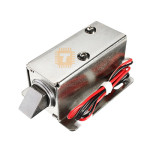
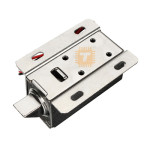
| Name | Solenoid Door Lock 12VDC 31x16x15mm |
| Code | RL0101 |
| Price | Rs.980.00 |
| In Stock | Yes |
| Package | SOLENOID |
Product Details
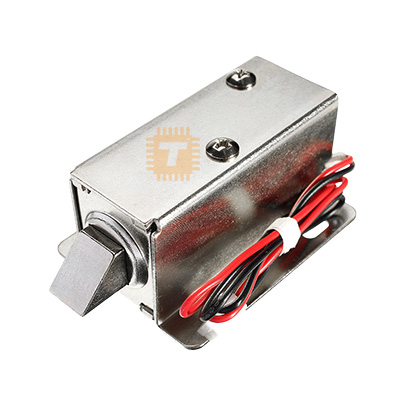
This 12VDC Solenoid Door Lock is a compact, robust electronic locking mechanism designed for automated security setups. Operating on a simple pull-solenoid principle, it features an iron core bolt that retracts immediately when a 12V pulse is applied, allowing a door, drawer, or lid to open. It is a favorite among makers and engineers for building smart cabinets, automated lockers, and low-voltage security enclosures.
Specifications
- Operating Voltage: 12V DC
- Operating Current: Approximately 0.6A to 0.8A (at 12V)
- Power Consumption: ~9.6W
- Lock Bolt Stroke (Travel Distance): 4mm to 5mm
- Unlocked Duration: Designed for intermittent triggering (<10>
- Body Dimensions: 31mm x 16mm x 15mm (L x W x H, excluding the latch bolt)
- Latch Bolt Dimensions: Extends roughly 7mm to 8mm from the housing body
- Wire Length: Standard 2-wire lead (approx. 10cm–15cm) with a termination connector (often XH-2.54)
Key Features
- Fail-Secure Operation (Normally Locked): The lock remains securely extended (locked) by an internal steel spring when power is turned off. It only retracts (unlocks) when 12VDC is actively supplied.
- Ultra-Compact Footprint: Measuring just 31x16x15mm, it fits easily inside narrow drawer slides, small jewelry boxes, or custom 3D-printed closures.
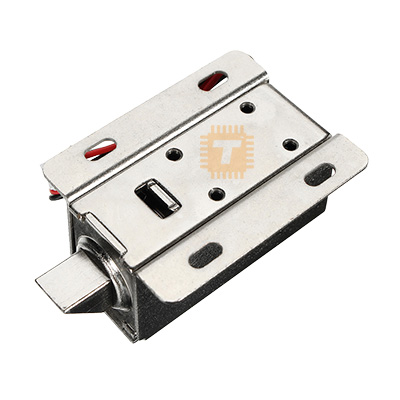
- 4-Way Adjustable Latch Orientation: The small beveled latch bolt can be unbolted, rotated in 90-degree increments, and re-secured, allowing you to configure it for left-handed, right-handed, top, or bottom-slamming doors.
- Slotted Mounting Holes: The outer chassis features small threaded or pass-through holes, making it easy to align precisely with your strike plate during physical installation.
Mechanism of Operation
- Power Off (Default State): An internal return spring pushes the iron core latch outward. If a door slams shut, the chamfered (beveled) edge allows the latch to retract mechanically and then snap back out into the strike plate, locking the door without electrical power.
- Power On (Energized State): Driving 12V DC through the internal copper coil creates a strong magnetic field. This electromagnetic force pulls the iron core inward into the solenoid body, compressing the spring and releasing the door latch.
Common Applications
- Smart Lockers & Parcel Delivery Boxes: Building RFID or keypad-accessible public locker grids.
- Automated Vending Machines: Dispensing products securely upon digital payment confirmation.
- Smart Home Furniture: Hidden drawers or gun safes triggered via Bluetooth, fingerprint scanners, or home automation systems.
- Robotics & DIY Projects: Building automated sorting traps or remote-controlled containment systems using Arduino, ESP32, or Raspberry Pi.
Interfacing and Driving Tips
- Do Not Hold Power Open Continuous: Solenoids are essentially electromagnets and act like high-current inductors. If you leave power applied to this tiny lock for more than 10 seconds at a time, the copper coil will quickly overheat, degrade the wire insulation, and melt or burn out. Keep your software unlock pulse brief (e.g., 500ms to 2 seconds is plenty of time for a user to open a latch).
- Flyback Diode Requirement: When the microcontroller cuts power to the solenoid, the collapsing magnetic field creates a massive reverse-voltage spike (flyback voltage). You must solder a flyback diode (such as a standard 1N4007) in parallel with the solenoid wires (Anode to Negative supply, Cathode to Positive supply) to prevent frying your driving circuit.
- Transistor/Relay Drive: A microcontroller pin (which outputs ~20mA) cannot drive this 800mA solenoid directly. You must use a relay module, an N-channel MOSFET (like the IRF540N), or a power transistor (like the TIP120) along with an external 12V power supply to handle the current load safely.
Sharing is caring, show love and share the product with your friends.
Featured
Add to Cart
Add to Cart
Other Products
Add to Cart
Add to Cart